
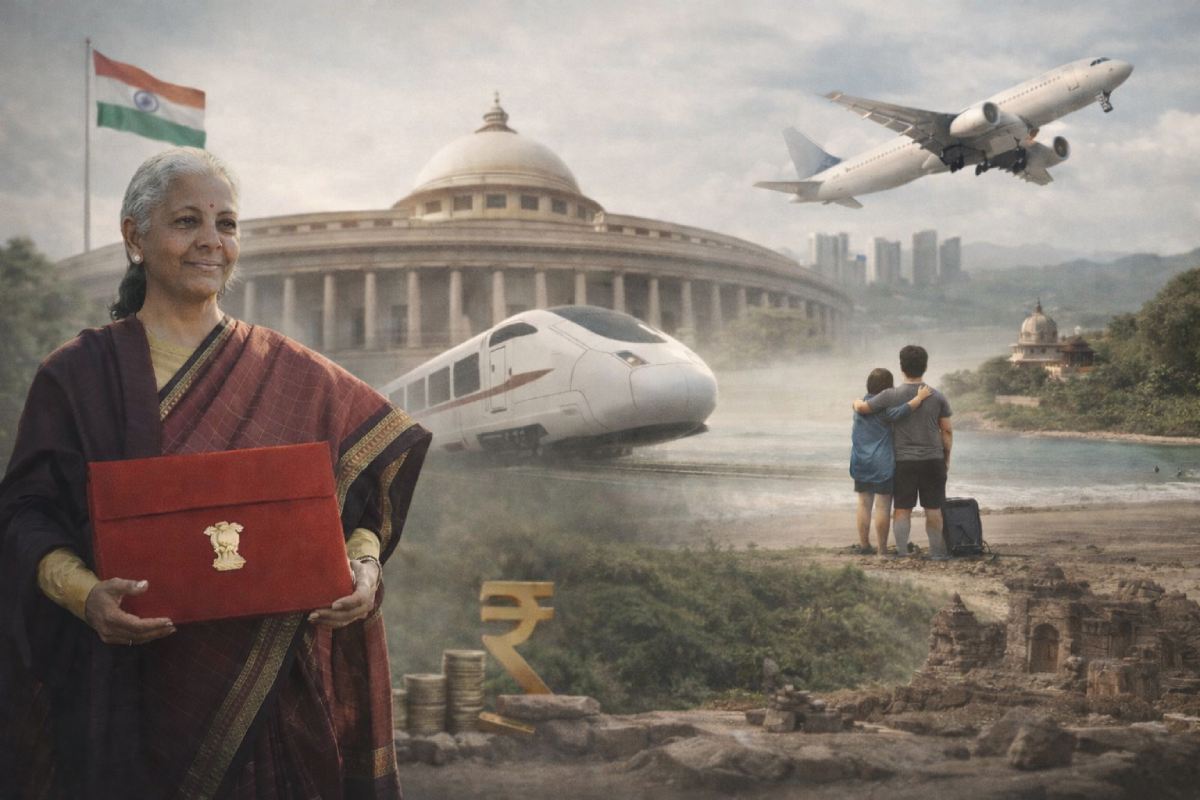
The Union Budget 2026-2027, presented by Finance Minister Nirmala Sitharaman, is about to change the way Indians travel, both within and outside the country. The Union Budget 2026 impact on travel will be a topic of discussion among travelers and travel experts alike.
From affordable international trips to upcoming rail corridors, here’s how the Union Budget 2026-27 will change the way Indians travel now!
Union Budget 2026 Impact On Travel: What Is Changing For Indian Travelers?
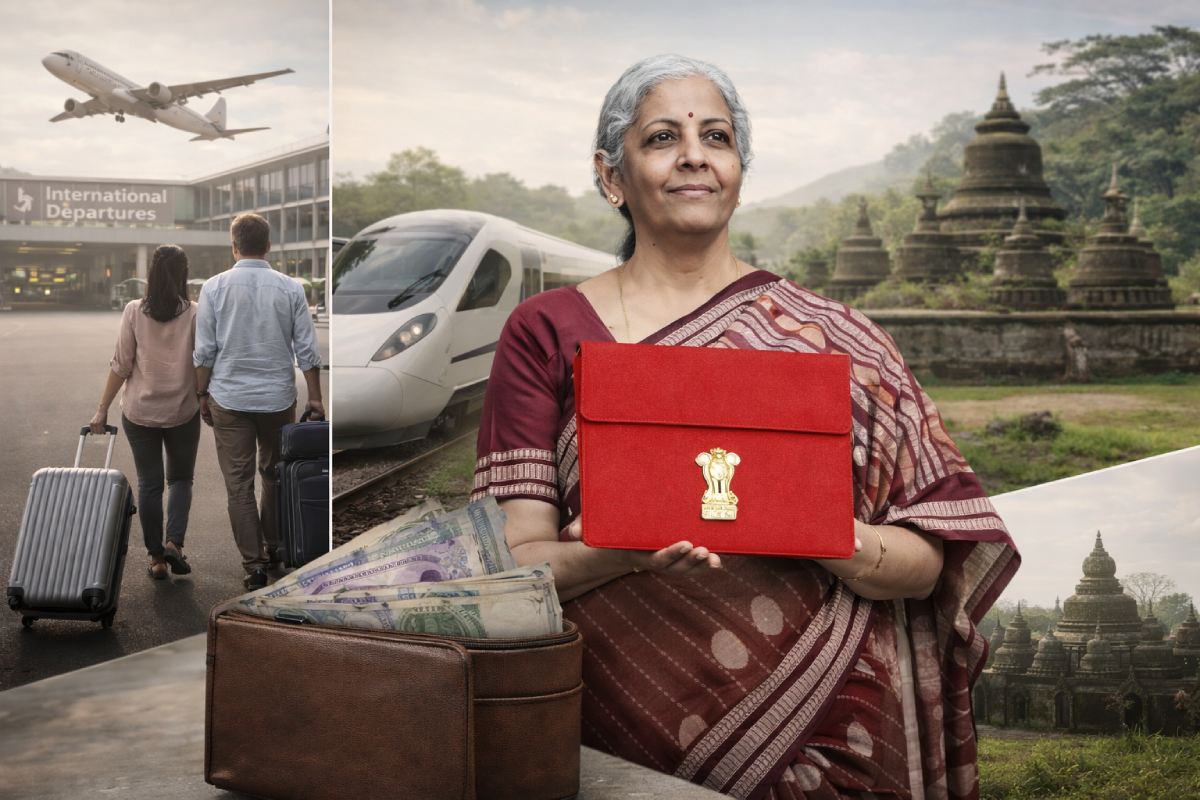
Cheaper International Travel With Reduced TCS!
TCS or Tax Collected at Source is the amount, in addition to the sale price, collected by a seller from a buyer on specific goods or services under Section 206C of the Income Tax Act, 1961.
TCS is collected on overseas tour packages. Prior to the Budget 202-27, TCS on overseas tour packages ranged between 5% and 20% depending on the amount.
However, with the Budget 2026-27, TCS on overseas tour packages has been reduced to a mere 2% with a ‘no minimum amount’ condition. This reduction in TCS will lower upfront cash outflow for Indians planning to book international trips.
Let’s take help of an example to better understand how reduced TCS will make international travel more affordable.
Assume that you’ve booked an overseas tour package worth INR 20 lakh which includes flights, bookings, and other costs. Earlier, under the Finance Act 2025, applicable TCS rates were between 5% and 20% as illustrated below:
For the first INR 10 lakh, 5% TCS was applicable: 5% of 10,00,000 = INR 50,000
For the remaining INR 10 lakh, 20% TCS was applicable: 20% of 10,00,000 = INR 2,00,000
Total upfront TCS: INR 2,50,000
After Budget 2026, TCS has been reduced to a flat 2% on the entire amount, i.e. INR 20 lakh.
For INR 20 lakh, 2% TCS will be applicable: 2% of 20,00,000 = INR 40,000
Total upfront TCS with 2% TCS = INR 40,000
Your upfront cash requirement drops from INR 2,50,000 to INR 40,000 – a significant savings of INR 2,10,000 at the time of booking!
A Boost In Efficient Domestic Connectivity With Seven High-Speed Rail Corridors

Indian tourism after Budget 2026, especially domestic travel, is about to get a lot faster and more efficient! The Budget 2026 announced the development of seven new high-speed rail corridors across India.
Union Budget 2026 impact on travel, then, will not be limited to international travel, but also boost domestic connectivity.
The seven high-speed rail corridors will significantly boost connectivity and reduce travel times between major urban centers. These high-speed rail corridors are as mentioned below:
- Mumbai-Pune
- Pune-Hyderabad
- Hyderabad-Bengaluru
- Hyderabad-Chennai
- Chennai-Bengaluru
- Delhi-Varanasi
- Varanasi-Siliguri
The newly proposed rail corridors are aimed at providing faster, environmentally sustainable travel. The rail corridors boost travel but also connect major industrial and economic hubs across India.
You May Like Also: Union Budget 2026: India To Get 7 High-Speed Rail Corridors – See Full Route List
Focus On Sustainable Travel Initiatives
In addition to pushing sustainable travel through the seven new high-speed rail corridors, Budget 2026 has proposed eco-tourism and nature-based travel initiatives.
These include sustainable trekking trails in Himachal Pradesh, Araku and Pudigai Valleys, Jammu & Kashmir, and Uttarakhand.
Budget 2026 has also proposed wildlife-focused trails such as the turtle-hatching routes in Odisha, Karnataka, and Kerala and several bird-watching paths around Pulicat Lake.
Development Of 15 Archaeological Sites
Budget 2026 impact on travel will see the development of 15 archaeological sites in India into vibrant cultural destinations.
With a renewed focus on India’s rich heritage, excavated landscapes will be opened to the public through curated walkways, immersive storytelling, and technology that will help preserve and disseminate valuable information about these places. Some of the key sites included in the development plan are as follows:
- Adichanallur in Tamil Nadu: One of the most important archaeological sites in India dating back to 3,000 years in the Iron Age.
- Leh Palace, Ladakh: A former royal palace built in 1600 AD.
- Sarnath, Uttar Pradesh: An important town near Varanasi where Gautam Buddha is believed to have delivered his first sermon.
- Dholavira, Gujarat: One of the most well-known archaelogical sites where remnants of the Harappan civilization lie intact. It is also a UNESCO World Heritage Site.
- Hastinapur, Uttar Pradesh: An ancient city that is believed to be the capital of the Kuru Kingdom in the Hindu epic Mahabharata.
Digital Knowledge Grid And Upskilling Of 10,000 Tourist Guides
Budget 2026 proposed the establishment of a National Destination Digital Knowledge Grid. What it’ll do is digitally document cultural, spiritual, and heritage sites across India, helping create a unified national repository of tourism assets.
It would improve information access for tourists and tour operators and aid destination planning and data-driven marketing.
Additionally, Budget 2026 also proposed a 12-week pilot program to train 10,000 tourist guides across 20 iconic destinations in India.
The initiative will not only boost employability but also enhance tourist experience. With guides receiving enhanced training, they’ll help create an immersive, culturally sensitive, and engaging experience for tourists.
A Boost In Astro-Tourism
Along with tourist guide upskilling and other travel-related initiatives, Budget 2026 also encouraged astro-tourism, a relatively niche segment in the Indian tourism industry. Budget 2026 has proposed telescope upgrades at key locations in India for improved night-sky experiences.
India’s astro-tourism industry could definitely benefit from this boost, thanks to the country being blessed with remote regions with low light pollution. Spiti Valley is a great example where astro-tourism is already thriving.
Development Of Buddhist Circuits In The North-East
Union Budget 2026 impact on travel will not be restricted to the means of travel but also focus on development of different pillars of the Indian tourism industry.
One such pillar is spiritual tourism, rapidly growing across spiritual centers in India. Budget 2026 has proposed development of the spiritual tourism industry in Buddhist circuits across North-East India, including Arunachal Pradesh, Assam, Manipur, Mizoram, Sikkim, and Tripura.
The proposed initiative will focus on preservation of monasteries and pilgrim centers and enhance connectivity between them.
Summing Up
Union Budget 2026 travel impact on Indian travelers will be seen in the way Indians travel, make travel package purchases, as well as in different aspects of tourism.
From new high-speed rail corridors and development of astro-tourism to development of Buddhist circuits in the North-East and reduced TCS, a lot is about to change for Indian travelers!